Offshore Corporate Services: The Eight Engagements, and What Each Excludes
Offshore corporate services are the engagements that form, bank and administer a company outside your country of residence. There are 8 of them, and they come in an order: the entity has to exist before a corporate bank account can. This page names each one, what it covers and what it does not.
WeOpenOffshore is an advisory and introduction service. We are not a law firm, a bank or a tax adviser, and we are not a licensed registered agent.
Sources verified .
What Offshore Corporate Services Are, and What They Are Not
Offshore corporate services means forming and administering companies, trusts and foundations under the laws of a jurisdiction outside your country of residence, and introducing them to banks. The engagement is the corporate structure itself: registering it, giving it a lawful home, and keeping it in good standing year after year.
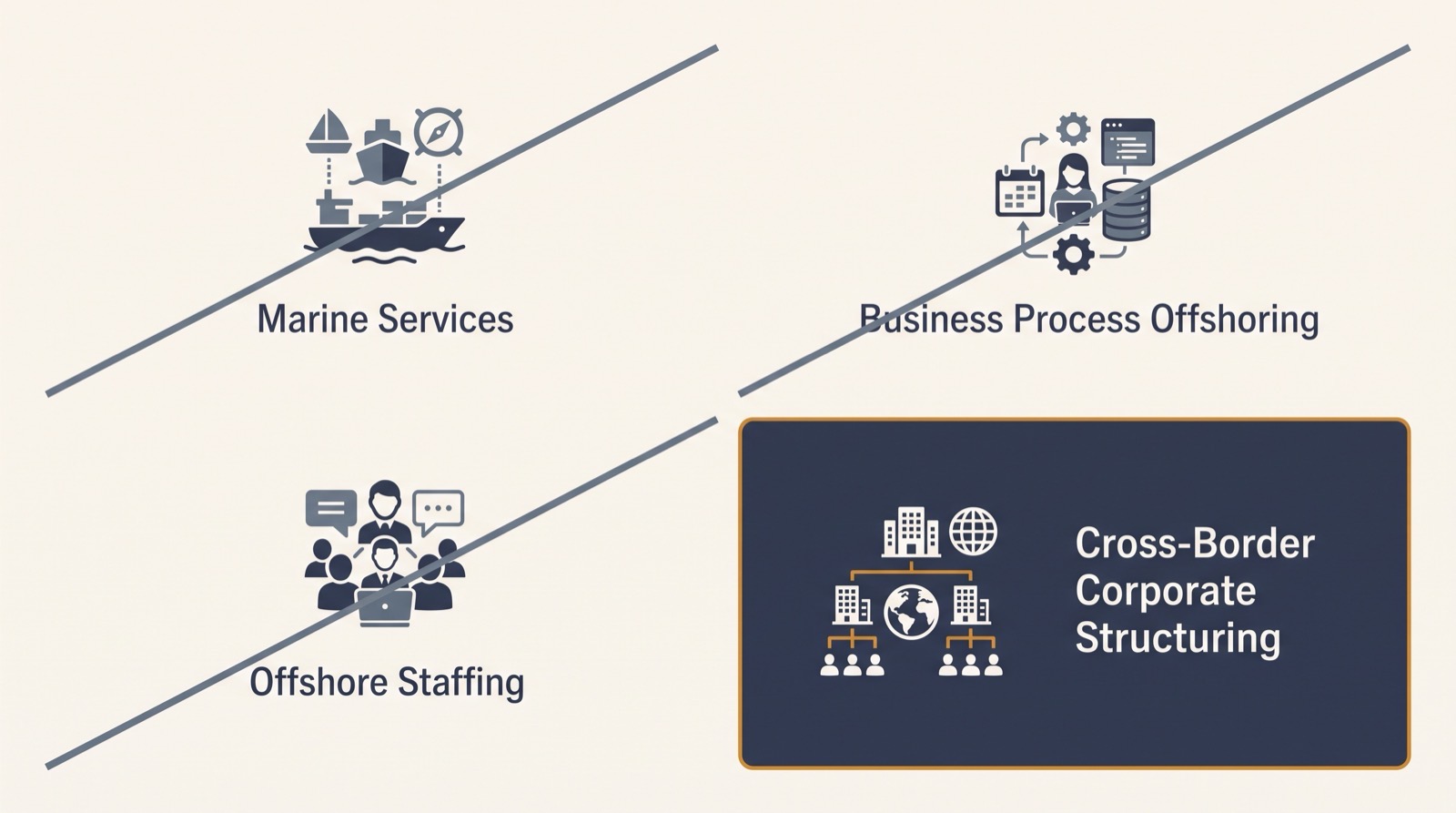
Three other trades use the same word, and on the bare term they take every result on the first page.
This is not offshore marine or oil-field services. It is not business-process offshoring, which means relocating part of your operations to another country. It is not offshore staffing. If you are looking for crew transfer vessels, a development team in another time zone, or a job on a rig, none of the eight services below will help you.
The distinction matters commercially, not only definitionally. A domestic company registration and an offshore corporate engagement share these keywords and are different products sold at different price points, so reading one against the other tells you nothing useful.
The industry term for a firm that provides these engagements is a corporate service provider, usually shortened to CSP. In the offshore jurisdictions that have a real regulator, this is a supervised activity rather than a trade anyone may enter. The Bermuda Monetary Authority lists Corporate Service Providers as one of the ten sectors it supervises, alongside banking, insurance and trust business. Conyers, one of the firms ranking on this query, discloses in its own footer that Conyers Corporate Services (Bermuda) Limited is licensed to conduct Corporate Service Provider Business by that authority.
That licensing point decides who is permitted to do which part of this work. It is answered in full further down.
The Eight Services, What Each Includes, and What It Does Not
Read the fourth column first. What a service leaves out decides more than what it covers, and it is the column nobody else in this market publishes.
| Service | What it is | What it includes | What it does not include | Who it suits |
|---|---|---|---|---|
| Offshore company formation | Registering a company under the laws of a jurisdiction outside your country of residence | Jurisdiction and entity-type selection, name check and reservation, the incorporation filing through a licensed agent, the constitutional documents, and the first year of registered agent and registered office | A bank account. Tax advice. Any promise about what the company will be taxed at where you live | Founders, holding structures, and owners of assets in more than one country |
| Offshore bank account | An introduction to a bank or payment institution that opens corporate accounts for non-resident companies | Matching your profile to institutions that currently accept it, preparing the application file, submitting the introduction, and managing the questions the bank comes back with | The account itself. The bank runs its own KYC and makes its own decision: we introduce, we do not guarantee an opening. Also excludes a personal account, and excludes the multi-currency payment-institution route, which is the offshore business account row below | An existing or newly formed company that needs to receive and hold money |
| Company and bank account together | The two engagements above, sequenced as one file | Formation, then the introduction, with the bank's requirements fed back into the choice of jurisdiction and entity before the company is registered | Any shortening of the bank's own review. Bundling changes the order of the work, not the bank's decision | Anyone starting from nothing who does not want to discover at the account stage that the jurisdiction was wrong |
| Offshore business account | An account with a licensed payment or electronic money institution rather than a bank, usually multi-currency and opened remotely | Institution selection, application preparation, and guidance on the activities and countries the institution will accept | Deposit protection, cash handling, and the correspondent banking reach a bank has. This is the alternative to the offshore bank account row above, not a cheaper version of it: choose between the two on what you need to do with the money | Businesses that need to send and receive in several currencies more than they need a balance sheet bank |
| US bank account for non-residents | Onshore United States, not offshore. A US account for a US or foreign company with no US-resident owner | Entity and documentation review against what US institutions ask a non-resident for, tax identification number guidance, and the introduction | Any offshore element. This row sits inside a US regulatory and reporting perimeter, and it is listed here because buyers ask for it in the same conversation, not because it is an offshore service | Non-residents selling into the United States who need to be paid there |
| Asset-protection trust and foundation | Settling a trust or establishing a foundation so that legal ownership of an asset passes to a trustee or a council | Structure selection, the jurisdiction and its statute, the deed or charter, trustee introduction, and the roles: settlor, trustee, protector, beneficiary | Keeping control of what you gave away. A trust works because control genuinely passes. It is not an alternative to a company, and it does not defeat a creditor you already have | Succession planning, and separating ownership from control for a reason you can state |
| High-risk merchant account | Card-processing capacity through an acquirer for a business other acquirers decline | Acquirer matching by industry and geography, the underwriting file, and coordination with the underlying entity and its account | The underlying business itself. A merchant account presupposes a lawful activity, and in some sectors a licensed one. Where the activity needs a licence, the licensing track is the complement to this row, not a competitor to it See financial licences by type. | Sectors acquirers class as high risk, including regulated ones with the licence already in place |
| Corporate administration | The annual work that keeps a registered entity in good standing | Registered agent, registered office, nominee director and nominee shareholder arrangements, virtual office, and economic substance support. Nominees are a governance and privacy arrangement, lawful in the jurisdictions where we offer them, and they do not conceal beneficial ownership from regulators, banks or tax authorities | A one-off purchase. The obligation begins the day the entity is registered, not at the first renewal. It also does not cover domestic United States registered agent work, which is a different product in a different market | Every company in the rows above, from day one |
Two of these are live: offshore company formation and offshore bank account introduction. The remaining six are named here with their scope and their exclusions, and each one gets its own page.
Financial Licences, and When a Company Is Not Enough
Some businesses need permission as well as a company. If you intend to hold client money, broker trades, handle virtual assets or run betting, the entity is the first step and a licence is the second. These are the five verticals we work on, and each is a financial licence by type rather than a service in the table above.
| Vertical | What it authorises | The licences within it |
|---|---|---|
| Payment and e-money | Issue electronic money, run payment accounts, and move client funds | Electronic money institution licence, EMI licence in Lithuania, payment institution licence in the United Kingdom, money services business registration in the United States and in Canada, money service operator licence in Hong Kong, and a payment services licence in Singapore |
| Forex and investment | Broker foreign exchange and securities for clients, and manage assets | Securities dealer and investment dealer licences in Seychelles, Mauritius, Vanuatu, Labuan and the Comoros, plus white-label forex, an asset management licence, and the licensing a proprietary trading firm needs |
| Crypto and virtual assets | Hold, exchange, transfer or safeguard virtual assets | Virtual asset service provider authorisation in Dubai, a crypto-asset service provider authorisation under MiCA in the European Union, and national routes in Lithuania, Poland, the Czech Republic, the Cayman Islands and the British Virgin Islands, plus decentralised autonomous organisation registration and tokenisation work |
| Gaming | Run online betting, casino or sportsbook operations | Gaming licences in Curacao, Anjouan, Malta, the Isle of Man, Kahnawake, Tobique and Costa Rica, and the licensing behind a crypto casino or a white-label casino |
| Banking | Take deposits and lend | Advisory scope only. Most founders who ask for a banking licence need an electronic money or payment institution licence instead, which carries a lower capital requirement in every regime we cover |
A licence is permission from a named regulator for one activity in one territory. It is not a status and it does not travel: an authorisation covering the European Economic Area covers the European Economic Area, and an offshore dealer licence covers its own regime and nothing beyond it.
The two tracks meet in one place. A high-risk merchant account presupposes a lawful underlying business, and in gaming and forex a licensed one, which is why the licence and the processing are bought together rather than instead of each other.
Fees, capital requirements and timelines are on the licensing hub and on each vertical page, sourced to the regulator that sets them. Nobody can promise a licence will be granted, and any adviser who does is telling you something about the rest of their advice.
Which One Do You Actually Need? The Order These Come In
Someone asked, in the search results for this page’s own query, what a good company that provides this service would be. The more useful question is which service. That one has a structural answer.
- 1
The entity comes first. A bank builds its customer file out of the certificate of incorporation and the constitutional documents. Until those exist there is nothing for the file to be built from, so a corporate account cannot precede the company it belongs to.
- 2
The account follows, and the bank decides. No adviser controls this step. What an adviser controls is which institutions see your file and how well it is put together.
- 3
Administration starts immediately. The registered agent, the registered office and the annual renewal begin on the day the company is registered. This is not a later purchase.
Two of the eight are not steps in that sequence at all.
A trust solves a different problem. A company is for trading and holding; a trust is for control and succession. They are not two answers to one question, and comparing them on price is a category error that will get you the wrong structure.
A merchant account sits at the end of a different chain. It presupposes a lawful underlying business, and in several sectors a licensed one, which is why it points at the licensing track rather than sitting beside it.
Then there is a question this page deliberately does not answer. Which service and which jurisdiction are separate decisions, and readers routinely collapse them into one. This page settles the first. For the second, see the jurisdictions we cover and how the jurisdictions compare.
What You Are Actually Paying For
The published tables in this field fuse the government fee and the provider’s fee into a single first-year figure, so nothing on any of them can be checked against a registry. That is a real problem, but it is not the deepest one. These eight services do not share a cost anatomy at all.
| Service | Government-set component? | Who sets the rest | One-off or annual | Verifiable against a public source? |
|---|---|---|---|---|
| Offshore company formation | Yes. The registry's incorporation fee is set by law | The licensed agent, and us | Both: incorporation, then annual renewal | Yes, against the registry's own published fee schedule |
| Offshore bank account | No. The counterparty is a commercial bank | The bank, and us | One-off introduction; the bank's own charges continue | No. Commercial terms, and they move without notice |
| Company and bank account together | Yes, for the company half only | Mixed | Both | Partly |
| Offshore business account | No. A licensed payment or electronic money institution | The institution, and us | Ongoing | No |
| US bank account for non-residents | No | The bank, and us | Ongoing | No |
| Asset-protection trust and foundation | Sometimes, where the trust is registrable | The trustee, and us | Settlement, then an annual trustee fee | Partly |
| High-risk merchant account | No. A discount rate and a rolling reserve, which are not fees | The acquirer | Ongoing, as a share of volume | No |
| Corporate administration | Yes. The annual registry renewal sits inside it | The licensed agent, and us | Annual, from the day the entity is registered | Yes, for the registry portion |
Read the first two rows against each other. Formation carries a statutory component: a registry publishes a fee schedule, the fee is set by law, and you can check the government half of any quote against it. A bank introduction carries no government component whatsoever, because the counterparty is a commercial bank and its charges are commercial terms.
Two rows are not fees in any sense. A merchant account’s discount rate and rolling reserve are a share of your volume, so they scale with the business rather than sitting on an invoice. And one row is unavoidable: corporate administration is annual from the day the entity is registered, which is the line most published guidance leaves out of the first-year number.
The figures themselves live on the full price list, which carries them per jurisdiction and per service.
Can You Do This Yourself?
Some of it, and the boundary is not where most readers expect. It is not a question of how hard the work is. It is a question of who is permitted to do it.
| Task | Do it yourself | Through a corporate service provider |
|---|---|---|
| Choosing the jurisdiction | You can, entirely. Nothing reserves this to anyone | We advise |
| Preparing your identity and address documents | You can, entirely | We tell you the standard required |
| Making the incorporation filing | In the jurisdictions we cover, you cannot. The statute reserves it | Filed by a licensed agent |
| Being the registered agent or registered office | You cannot. It is a licensed activity | Provided by the licensed agent |
| Opening the bank account | You can apply directly. No licence is needed to open your own account | We introduce; the bank decides |
| Ongoing filings and renewals | Some yes; the registered-agent function no | Administered |
| What is never on offer | Approval. The registry and the bank decide | Approval. The registry and the bank decide |
Two statutes we work under say this in terms. The BVI Business Companies Act provides at section 6(2) that an application to incorporate “may be filed only by the proposed registered agent and the Registrar shall not accept an application for the incorporation of a company filed by any other person”, and at section 91(3) that nobody may be a registered agent unless they hold a licence under the Company Management Act or the Banks and Trust Companies Act. The Seychelles International Business Companies Act 2016 is built the same way: section 9(2) says an incorporation application “shall only be filed by its proposed registered agent”, and section 164(2) says nobody may act as one unless licensed to provide international corporate services.
So the reason to use a provider is not speed and it is not price. Part of this work is a licensed activity you are not permitted to perform, and the rest is perishable knowledge about which registries and which banks currently accept which profiles.
Which makes it worth saying plainly what we are. WeOpenOffshore is not a law firm, not a bank, not a tax adviser, not a licensed registered agent and not a trustee. Conyers is a licensed corporate service provider; we are not. Where a jurisdiction reserves the filing to a licensed agent, a licensed agent makes it, and we say which one.
What You Still Owe Your Own Tax Authority
Owning a company abroad is lawful. Cornell’s Legal Information Institute defines an offshore corporation as “a legal entity formed under the laws of a jurisdiction outside of the United States”. That definition is written from a US standpoint. Read from anywhere else, the jurisdiction that matters is your own, and forming a company outside it is an ordinary commercial act.
Legality is not the question that decides anything, though. Reporting is, and it does not move when the company does.
| Market | What you still file |
|---|---|
| United States | Form 5471 where you are an officer, director or shareholder in certain foreign corporations, under 26 U.S.C. sections 6038 and 6046. FinCEN Form 114, the FBAR, where your foreign financial accounts exceeded USD 10,000 in aggregate at any time in the calendar year, the same threshold set at 31 CFR 1010.306(c). Form 8938 from USD 50,000 in specified foreign financial assets held on the last day of the tax year by a single resident filer, or USD 75,000 at any time during it. Dropping the year-end qualifier points a reader at the wrong number. The reporting duty is imposed by 26 U.S.C. section 6038D. A foreign company is a controlled foreign corporation where United States shareholders own more than 50% of its voting power or value, which pulls controlled-foreign-corporation income into your return. Note the naming: the heading of section 951A now reads net CFC tested income, while Form 8992 still says GILTI. |
| United Kingdom | Foreign income through Self Assessment, and the Channel Islands and the Isle of Man count as foreign. Then a split that is regularly got wrong: the controlled foreign company charge under Part 9A TIOPA 2010 falls on UK-resident companies, and only on an interest of at least 25%. HMRC’s own manual puts it the same way: a CFC charge is charged on each chargeable company holding a relevant interest. A UK-resident individual who transferred assets into the structure is instead within the transfer of assets abroad rules at sections 714 to 751 of the Income Tax Act 2007. These are two different charges on two different taxpayers. |
| India | The Liberalised Remittance Scheme allows a resident individual USD 250,000 per financial year, and the Reserve Bank states the Scheme is not available to corporates, partnership firms, HUF or Trusts. An Indian company therefore cannot fund an offshore structure through it. Equity in a foreign entity is Overseas Direct Investment, which requires a UIN from the Reserve Bank before any remittance and runs through your authorised dealer bank rather than around it. Your authorised dealer also collects tax at source on Scheme remittances above ten lakh rupees under section 206C(1G), at 20% where the purpose is neither education nor medical treatment. It is collected, not charged: you set it against your own tax liability. |
| United Arab Emirates | Federal corporate tax at 0% up to a statutory threshold and 9% above it, under Federal Decree-Law No. 47 of 2022. A Qualifying Free Zone Person is the correction most of this field gets backwards: it gets no nil band at all, and keeps 0% only on Qualifying Income and only while it maintains adequate substance. Economic substance notifications and reports were cancelled for financial years ending after 31 December 2022 by Cabinet Decision No. 98 of 2024, which amends the 31 of 2019 to 57 of 2020 chain. Do not file one for a current year. The Ministry’s own landing page still describes the old filing duty and does not flag the cancellation, so read the decision, not the page. |
Two more obligations sit above all four columns. Under the OECD Common Reporting Standard, account information is exchanged automatically between participating jurisdictions, so the account your structure holds is visible to the tax authority where you are resident. And where a jurisdiction is on the FATF list of jurisdictions under increased monitoring or the EU list of non-cooperative jurisdictions for tax purposes, we say so on the page for that jurisdiction. Both lists move: FATF revises at each plenary, three times a year, and the EU Council revises in February and October.
The filing mechanics belong on the legality answer page rather than here.
What Happens After Setup, and How to Start
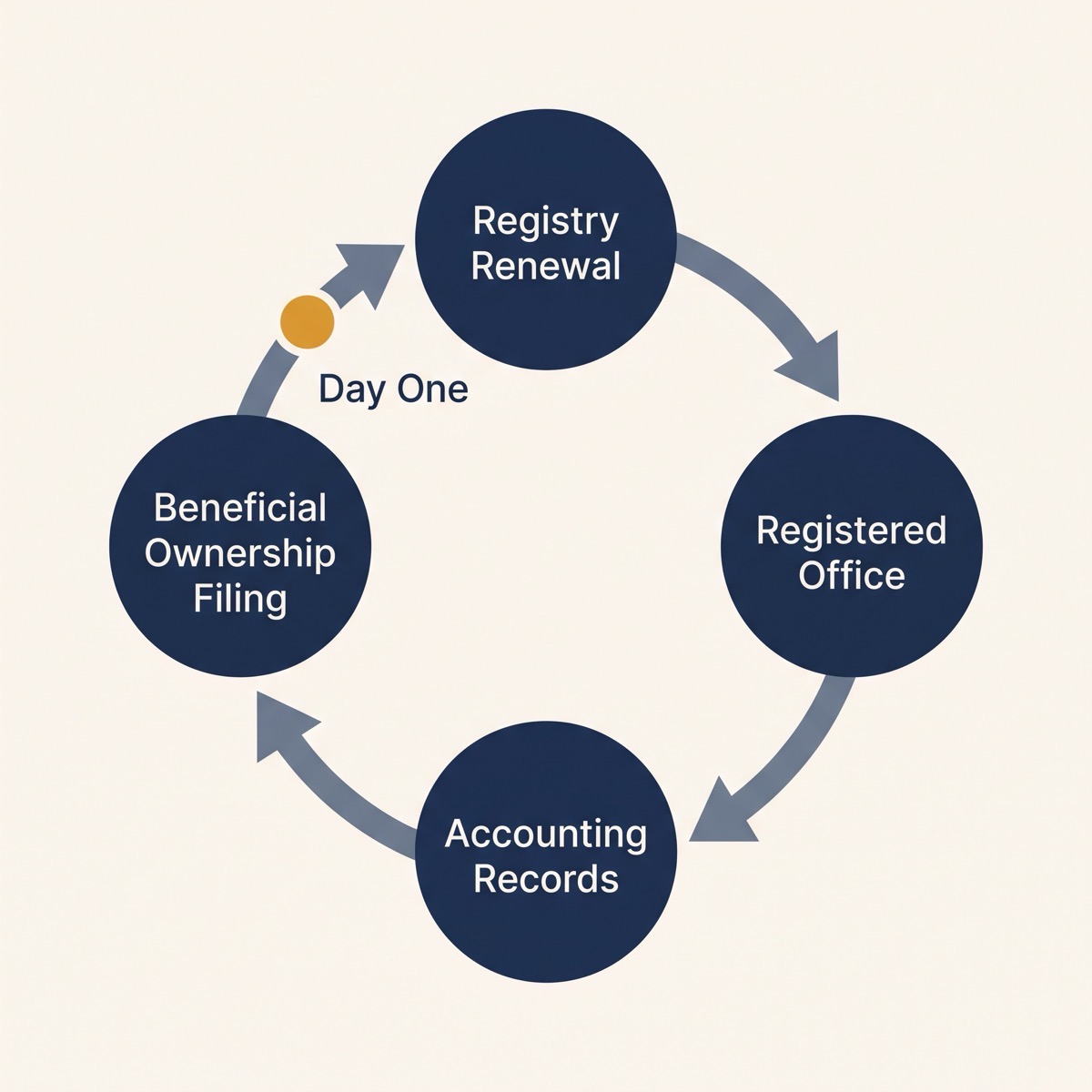
Every competitor page in this field stops at incorporation. That is the wrong place to stop, because the obligation starts there. The registry renewal, the registered office, the accounting records and the beneficial-ownership filing are annual, and the clock on all four begins on the day the entity is registered.
Who this does not suit
If you want a structure whose beneficial owner cannot be identified by a regulator or a bank, we are the wrong adviser and so is anyone who tells you yes.
If you want to stop reporting at home, no structure on this page does that.
If you already have a judgment or a live dispute, a trust settled now is unlikely to help you and may make things worse.
If you want the cheapest possible registration with no annual support, a domestic registration in your own country will beat anything here on price.
If none of those describe you, the next step is a conversation about which of the eight you actually need, in what order.
Offshore services FAQ
What are offshore corporate services?
Forming and administering companies, trusts and foundations outside your country of residence, and introducing them to banks. They are not offshore marine or oil-field services, not business-process offshoring, and not offshore staffing. In the jurisdictions we cover, providing them is a licensed activity.
Which offshore service do I need?
It depends on the problem, not the price. A company is for trading and holding, a trust is for control and succession, an account is for receiving money, and administration is what keeps the entity in good standing. They also come in a dependency order: the entity has to exist before a corporate account can be opened, because the bank builds its file from the certificate of incorporation.
What do offshore corporate services cost?
Eight services, four different cost anatomies. Formation carries a government-set registry fee you can check against the registry's own schedule. A bank introduction carries no government fee at all, because the counterparty is a commercial bank whose charges are commercial terms. Full figures are on the price list and on each service page.
Can I set up an offshore company myself?
In the jurisdictions we cover, no, and not because it is difficult. The BVI Business Companies Act at section 6(2) and the Seychelles International Business Companies Act 2016 at section 9(2) both reserve the incorporation filing to the proposed registered agent, and both require that agent to be licensed. It is a permission question, not a difficulty question. What you can do yourself is choose the jurisdiction, prepare your documents, and apply to a bank directly.
Is it legal to have an offshore company?
Yes. An offshore corporation is a legal entity formed under the laws of a jurisdiction outside your own. Legality is not the question that matters; reporting is, and you keep reporting at home.
Do these services change what I owe my own tax authority?
No. You remain responsible for reporting in your country of residence. A US person files FinCEN Form 114, Form 5471 and Form 8938 where the thresholds are met. A UK resident reports foreign income through Self Assessment, with the controlled foreign company charge falling on UK-resident companies and the transfer of assets abroad rules on individuals. In India the Liberalised Remittance Scheme is not available to companies. Under the Common Reporting Standard, account information is exchanged automatically.
Not sure which of the eight you need?
Tell us what the structure is for and where you are tax resident. We will tell you which services that actually requires, in what order, and whether we think you should proceed.
What we are not. WeOpenOffshore is an advisory and introduction service, not a law firm, not a bank, not a tax adviser, not a licensed registered agent and not a trustee. Nothing on this page is legal or tax advice.
Filings. Where a jurisdiction reserves the incorporation filing to a licensed registered agent or corporate service provider, that filing is made by a licensed agent, not by us.
Banking. Accounts are subject to the bank’s own KYC and approval. We introduce; we do not guarantee an account opening.
Nominees. Nominee director and nominee shareholder arrangements are a governance and privacy arrangement, lawful in the jurisdictions where we offer them. They do not conceal beneficial ownership from regulators, banks or tax authorities.
Reporting. You remain responsible for reporting your interest in any foreign company, trust or account to the tax authority where you are resident.
Sources on this page are taken from the registry, regulator, statute or tax authority named beside each claim, and were verified on . Rules and thresholds change. Check the linked source, or ask us, before you rely on one.